Curbside Pickup
21 minute read
Imagine a store running curbside pickup. The retail team manages customer orders in one database and marks an order ready when it’s prepared. Independently, the physical operations team tracks pickup vehicles in another database, and a driver sets their location to Curbside when they arrive. The two systems never talk to each other.
You want a single live dashboard with six panels:
- an Orders · Preparing panel and an Orders · Ready panel, so an order visibly moves from one to the other the moment it’s marked ready,
- a Vehicles · Parking panel and a Vehicles · Curbside panel, so a car moves between them as the driver pulls up, plus the two situations that matter:
- a Matched Orders panel that lights up the instant an order is ready and its driver is at the curbside, so staff know exactly which order to carry out, and
- a Delayed Orders panel that flags drivers who have been waiting at the curbside too long while their order still isn’t ready.
The catch: the orders live in PostgreSQL and the vehicles live in MySQL, and what you care about - a ready order whose driver has arrived - only exists when you combine a fact from each. Building this the traditional way means polling both databases, and that’s where it gets awkward. Do you poll the orders, and for each ready one go look up its vehicle in the other database? Then a car pulling up to the curbside changes nothing until your next orders poll happens to re-check it - you react to order changes but sit blind to vehicle changes between polls. Flip it around and poll the vehicles instead, and now you’re blind to an order flipping to ready. Either way you get reactivity from one side and stale, interval-delayed lookups on the other, and the more sources you add the worse the fan-out of cross-database queries gets. This tutorial builds it on Drasi Server instead: two sources, six continuous queries (two of which join across both databases), and the built-in dashboard reaction - no application code to write. Drasi watches the change feed of both databases at once, so a change on either side re-evaluates the join immediately - no polling, no blind side. A small browser-based operations console stands in for the two operations teams so you can drive the changes yourself and watch every SQL statement as it runs.
| Step | What You’ll Do |
|---|---|
| Step 1: Set Up Your Environment | Open the dev container (or install the tools locally) |
| Step 2: Run the Demo | One command starts both databases, Drasi Server, and the operations console |
| Step 3: Open the Dashboard | Watch all six panels update live |
| Step 4: Drive Change | Use the browser console to change orders and vehicles, and watch Drasi react |
| How It Works | Understand the two sources, the cross-database join, and the six queries |
- One terminal: a single command starts the databases, Drasi Server, and the operations console together; it stays in the foreground. You drive changes from your browser.
- Working directory: run every command from the tutorial directory (
tutorials/curbside-pickup/). The dev container opens there automatically; if you’re running locally,cd tutorials/curbside-pickupfirst. - Command tabs: commands are shown in tabs (bash / zsh and PowerShell). Use the one for your shell. The dev container and Codespaces use bash.
- Ports: the Drasi Server API is on
8480, the dashboard is on3000, the operations console is on3001, PostgreSQL is published on5742, and MySQL on3309.
Step 1 of 4: Set Up Your Environment
This tutorial needs Docker (it runs PostgreSQL and MySQL) and Node.js 18+ (for the operations console). The easiest way to get everything is the dev container.
Option A: Dev Container or GitHub Codespaces (recommended)
- Open this repository in VS Code and run Reopen in Container (or create a Codespace from the repo’s Code menu).
- When prompted for a configuration, choose Drasi Server - Curbside Pickup Tutorial.
- Wait for the container to finish. Its setup script downloads the Drasi Server binary and installs the console’s dependencies.
That’s it. Skip ahead to Step 2.
Option B: Run Locally
You’ll need Docker, Node.js 18+, and bash (the helper scripts use it; on Windows use Git Bash or WSL, or use the PowerShell tabs). From the repository root, move into the tutorial directory and download the Drasi Server binary:
cd tutorials/curbside-pickup
bash scripts/download.sh
cd tutorials/curbside-pickup
powershell -ExecutionPolicy Bypass -File scripts/download.ps1This places the binary at bin/drasi-server (or bin\drasi-server.exe on Windows) inside the tutorial directory.
Option C: Build from Source
Prefer to compile Drasi Server yourself? Follow the Build from Source installation guide to clone the repository and build the binary.
Once it is built, make the drasi-server binary available to this tutorial’s helper scripts — either add it to your PATH, or copy it into this tutorial’s bin/ directory (the same location Option B uses):
cd tutorials/curbside-pickup
mkdir -p bin
cp /path/to/drasi-server/bin/drasi-server bin/drasi-server
cd tutorials/curbside-pickup
New-Item -ItemType Directory -Force bin | Out-Null
Copy-Item C:\path\to\drasi-server\bin\drasi-server.exe bin\drasi-server.exeStep 2 of 4: Run the Demo
Everything runs from a single configuration file, server-config.yaml. Start the demo:
bash scripts/start-demo.shpowershell -ExecutionPolicy Bypass -File scripts/start-demo.ps1The start-demo script does three things:
- Starts the databases. PostgreSQL comes up with logical replication enabled and the
orderstable seeded (three orders, all preparing). MySQL comes up with ROW-based binary logging (and GTID mode) enabled on thevehiclestable (three vehicles, all Parking) - the plates match the orders. - Runs Drasi Server in the foreground with the full configuration.
- Starts the operations console (a small Node.js app) in the background on port
3001, so you have everything you need from this one command.
On first start, Drasi Server downloads the plugins it needs (source/postgres, bootstrap/postgres, source/mysql, bootstrap/mysql, reaction/dashboard) from ghcr.io/drasi-project and caches them under ~/.drasi/plugins, connects to both databases, bootstraps the existing rows, starts the six continuous queries, and starts the dashboard. When you see a line like the following, it’s ready:
Drasi Server started successfully with API on port 8480
Leave this running. Everything else happens in your browser.
Press Ctrl+C in the terminal to stop the server and the operations console together. To remove the database containers when you’re completely done, run bash scripts/cleanup.sh (bash) or powershell -ExecutionPolicy Bypass -File scripts/cleanup.ps1 (PowerShell). Add --volumes to also delete the database data.
Step 3 of 4: Open the Dashboard
Drasi Server’s dashboard reaction hosts the live dashboard; there’s no separate app to build or run. Wait until the terminal prints Drasi Server started successfully (the first run takes a little longer while the plugins download), then open it in your browser:
http://localhost:3000
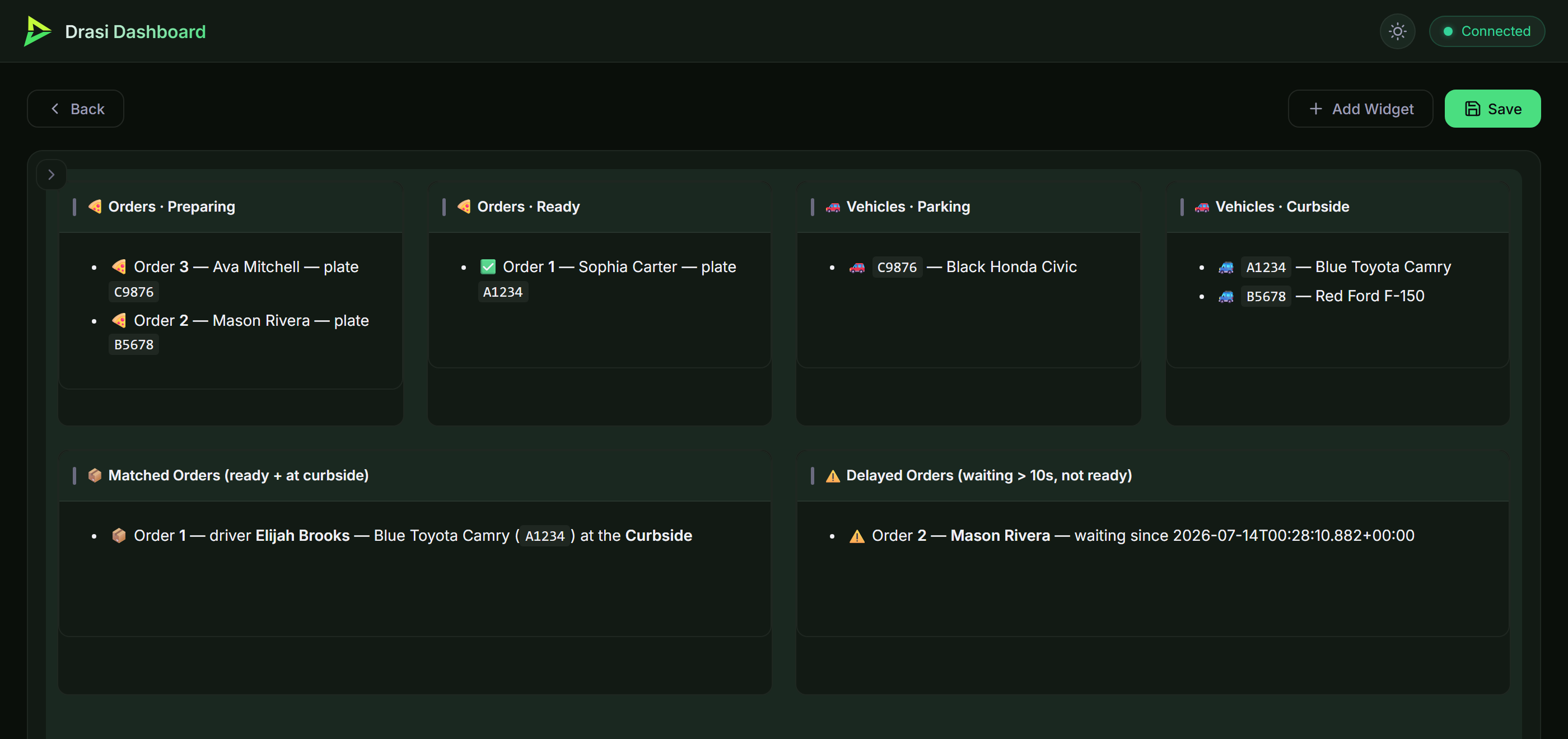
In the dev container or Codespaces, port 3000 is forwarded automatically. Open the seeded Curbside Pickup dashboard. It has six Markdown panels: the four list panels sit side by side on the top row, with the two join panels below:
- 🍕 Orders · Preparing and 🍕 Orders · Ready - every order in PostgreSQL, split by status. An order appears in exactly one of the two, and jumps from Preparing to Ready the instant its status changes.
- 🚗 Vehicles · Parking and 🚗 Vehicles · Curbside - every vehicle in MySQL, split by location. A vehicle moves from Parking to Curbside the instant its location changes.
- 📦 Matched Orders - orders that are ready whose driver is at the Curbside (the
deliveryquery). - ⚠️ Delayed Orders - drivers who have waited at the curbside for more than 10 seconds while their order is still being prepared (the
delayquery).
At bootstrap all three orders are preparing and all three vehicles are in Parking, so those two panels list every row while their Ready and Curbside counterparts start empty. The Matched Orders and Delayed Orders panels also start empty - no order is ready and no vehicle is at the Curbside yet - and fill in as you drive changes. Every panel updates the instant the data changes, with no refreshing; because each panel is backed by a filtered continuous query, a row simply disappears from one panel and reappears in the other as it changes.
Step 4 of 4: Drive Change
You drive changes from an operations console - the small browser app that start-demo launched alongside Drasi Server. It connects directly to both databases and, as you make changes, prints every SQL statement it runs and which database it hit, so you can see exactly what Drasi is reacting to. Open it in your browser:
http://localhost:3001
It has two panels - Retail Operations (the PostgreSQL orders table) and Physical Operations (the MySQL vehicles table) - and a live SQL log beneath them. Each row has a button that toggles it: mark ready → / to Curbside → and back. As you click, the SQL log fills in, colour-coded by database.
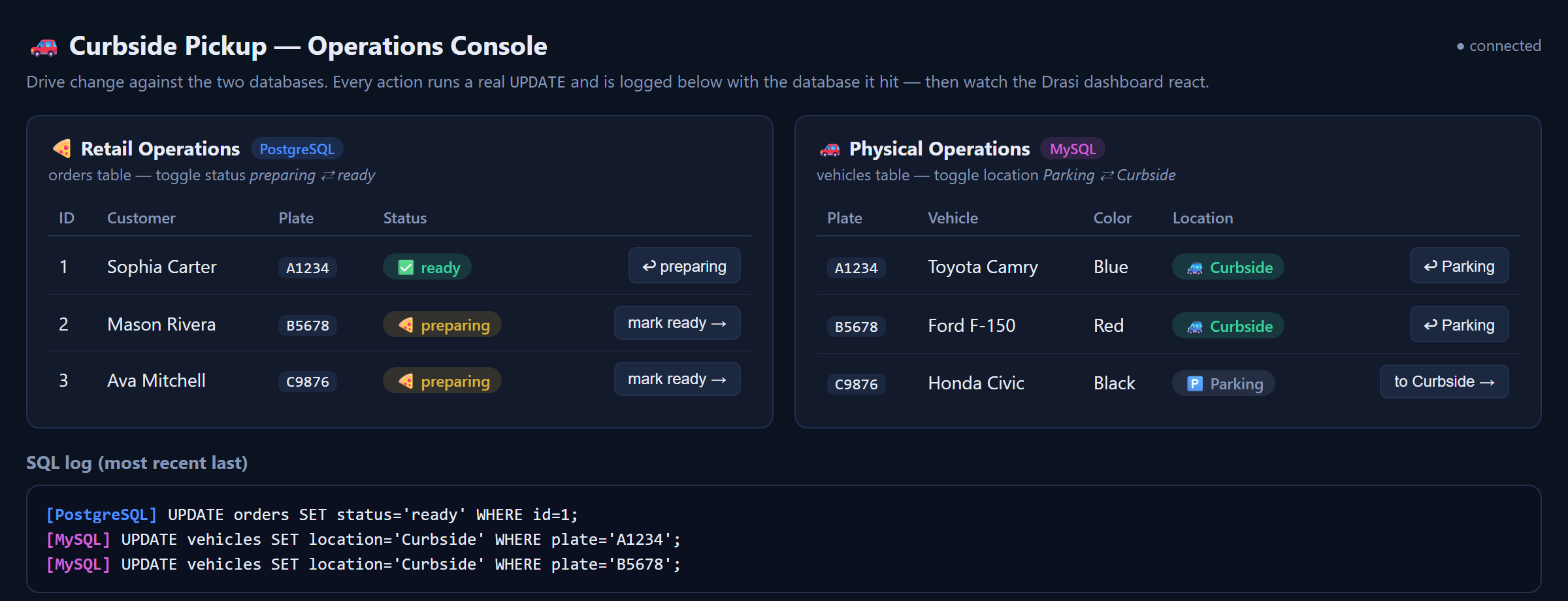
Keep the dashboard (http://localhost:3000) open in another tab or window so you can watch it react as you drive changes here.
Trigger a delivery
Mark order A1234 (Sophia Carter) ready. The console logs:
[PostgreSQL] UPDATE orders SET status='ready' WHERE id=1;
Watch the dashboard: order A1234 immediately leaves the 🍕 Orders · Preparing panel and appears in 🍕 Orders · Ready. Now move vehicle A1234 to Curbside:
[MySQL] UPDATE vehicles SET location='Curbside' WHERE plate='A1234';
The vehicle jumps from 🚗 Vehicles · Parking to 🚗 Vehicles · Curbside, and within about a second the 📦 Matched Orders panel reacts: order A1234 appears with its driver and vehicle. Nothing polled anything - Drasi saw the PostgreSQL change through logical replication and the MySQL change through the binary log, and re-evaluated the cross-database join.
Move the vehicle back to Parking and the row disappears from Matched Orders: the order is no longer matched to a waiting driver.
Trigger a delay
Now reproduce the other scenario. Pick a vehicle whose order is not ready - say B5678 (Mason Rivera) - and move it to Curbside, but leave order B5678 as preparing. Nothing happens immediately. After 10 seconds the Delayed Orders panel lights up: order B5678 appears, flagging that the driver has been waiting too long.
This is the interesting one. Drasi doesn’t poll to find slow orders - the continuous query schedules its own future re-evaluation for the moment the 10-second threshold is crossed, and fires exactly then. If you mark the order ready (or send the driver back to Parking) before the 10 seconds elapse, the alert never appears.
Reset
Return everything to the starting state (all orders preparing, all vehicles Parking):
bash scripts/reset.shpowershell -ExecutionPolicy Bypass -File scripts/reset.ps1How It Works
Everything you just ran is described by the single server-config.yaml. Here’s what each part does.
Two Sources
The queries join data from two different databases, so the configuration declares two sources.
PostgreSQL holds the orders and streams changes via logical replication (CDC):
sources:
  - kind: postgres
    id: retail-ops
    # ... connection settings ...
    tables:
      - orders
    tableKeys:
      - table: orders
        keyColumns:
          - id
    bootstrapProvider:
      kind: postgres
MySQL holds the vehicles and streams changes via its binary log (binlog). The Drasi source reads the binlog directly, so database/docker-compose.yml starts MySQL with ROW-based logging, full row images/metadata, and GTID mode, and database/mysql-init.sql grants the Drasi user the replication privileges it needs:
  - kind: mysql
    id: physical-ops
    # ... connection settings ...
    sslMode: disabled
    tables:
      - vehicles
    tableKeys:
      - table: vehicles
        keyColumns:
          - plate
    bootstrapProvider:
      kind: mysql
      # ... the MySQL bootstrap provider takes its own connection settings ...
Each table row becomes a graph node. The orders table becomes orders nodes and the vehicles table becomes vehicles nodes, matching the (o:orders) and (v:vehicles) patterns in the queries.
The Synthetic Join
There is no foreign key between the two databases - they’re completely separate systems. Drasi creates the relationship in the query with a synthetic join, matching a vehicle to an order whenever their plate values are equal:
joins:
  - id: PICKUP_BY
    keys:
      - label: vehicles
        property: plate
      - label: orders
        property: plate
The queries then walk that relationship with (o:orders)-[:PICKUP_BY]->(v:vehicles) as if it were a real graph edge - across two different databases.
The Six Continuous Queries
Four of the queries are simple single-source lists, filtered by state, that feed the split Orders and Vehicles panels. Because each one matches only part of the table, a row leaves one query’s result and joins the other’s the instant its status or location changes - which is exactly what makes it hop between panels on the dashboard. orders-preparing and orders-ready split the PostgreSQL orders by status:
MATCH
  (o:orders)
WHERE o.status <> 'ready'          // orders-ready uses: o.status = 'ready'
RETURN
  o.id AS orderId,
  o.customer_name AS customerName,
  o.driver_name AS driverName,
  o.plate AS plate,
  o.status AS status
and vehicles-parking and vehicles-curbside split the MySQL vehicles by location:
MATCH
  (v:vehicles)
WHERE v.location = 'Parking'        // vehicles-curbside uses: v.location = 'Curbside'
RETURN
  v.plate AS plate,
  v.make AS make,
  v.model AS model,
  v.color AS color,
  v.location AS location
The other two join across both databases. Delivery returns an order whenever it is ready and its driver’s vehicle is at the Curbside. Because every order starts preparing and every vehicle starts Parking, a row can only appear once real changes move an order to ready and a vehicle to curbside, so the dashboard starts empty and fills in as changes are driven live:
MATCH
  (o:orders)-[:PICKUP_BY]->(v:vehicles)
WHERE o.status = 'ready'
AND v.location = 'Curbside'
RETURN
  o.id AS orderId,
  o.driver_name AS driverName,
  o.plate AS vehicleId,
  v.make AS vehicleMake,
  v.model AS vehicleModel,
  v.color AS vehicleColor,
  v.location AS vehicleLocation,
  drasi.listMax([drasi.changeDateTime(o), drasi.changeDateTime(v)]) AS readyTimestamp
Delay returns an order whose driver has been at the Curbside for more than 10 seconds while the order still isn’t ready. It uses drasi.trueFor, which schedules a future re-evaluation and fires the moment the condition has held for the given duration, so the order appears exactly when the 10-second threshold is crossed:
MATCH
  (o:orders)-[:PICKUP_BY]->(v:vehicles)
WHERE o.status <> 'ready'
AND drasi.trueFor(v.location = 'Curbside', duration({ seconds: 10 }))
RETURN
  o.id AS orderId,
  o.customer_name AS customerName,
  drasi.changeDateTime(v) AS waitingSinceTimestamp
Both the PostgreSQL and MySQL sources stamp every change with the wall-clock time it happened, which drasi.changeDateTime() exposes. drasi.trueFor uses that timestamp to anchor its 10-second timer - so the delay query fires exactly when a curbside vehicle has waited long enough - and the delay panel reports it as waitingSinceTimestamp, with no extra timestamp columns or application bookkeeping required.
The Dashboard Reaction
A single dashboard reaction subscribes to all six queries and seeds one Curbside Pickup dashboard on first start. It lays out six Markdown (text) widgets on a 12-column grid; each widget names one query and renders that query’s rows with a Handlebars template - no KPIs or tables to configure, just a list. Here’s the reaction envelope plus one representative widget (the other five follow the same shape):
reactions:
  - kind: dashboard
    id: curbside-dashboard
    queries:
      - orders-preparing
      - orders-ready
      - vehicles-parking
      - vehicles-curbside
      - delivery
      - delay
    port: 3000
    predefinedDashboards:
      - id: curbside-pickup
        name: Curbside Pickup
        gridOptions:
          columns: 12
          rowHeight: 60
          margin: 10
        widgets:
          # The four list panels sit side by side on the top row (w: 3 each);
          # the two join panels (delivery, delay) span the row below (w: 6).
          - id: orders-preparing
            type: text
            title: 🍕 Orders · Preparing
            grid: { x: 0, y: 0, w: 3, h: 4 }
            config:
              queryId: orders-preparing
              # Handlebars: loop the query's `rows` into a Markdown list.
              template: |
                {{#if count}}
                {{#each rows}}
                - 🍕 Order **{{this.orderId}}** — {{this.customerName}} — plate `{{this.plate}}`
                {{/each}}
                {{else}}
                _No orders being prepared._
                {{/if}}
          # - orders-ready, vehicles-parking, vehicles-curbside (top row) ...
          # - delivery, delay (bottom row, w: 6 each) ...
Each text widget’s template loops over its query’s rows and prints a Markdown bullet per result (or the {{else}} placeholder when empty); when a query’s result set changes, the reaction pushes the update to the browser. That’s the whole UI - no front-end code to write or host.
Driving Change
The operations console (webui/) is a small Node.js app - a tiny Express server serving a static page - that connects straight to PostgreSQL and MySQL and runs ordinary UPDATE statements, the same kind your real retail and physical-operations apps would run. start-demo launches it alongside Drasi Server and stops it again on Ctrl+C. It’s a convenience for the tutorial, not part of Drasi: Drasi reacts to the database changes however they’re made.
Putting It All Together
The sections above walked through the configuration one piece at a time. Here
is the complete server-config.yaml that start-demo actually runs - both
sources, all six continuous queries, and the full dashboard reaction in a
single file:
# =============================================================================
# Drasi Server - Curbside Pickup Tutorial
# =============================================================================
# Powers a single real-time dashboard over two independent databases:
#   - retail-ops   : a PostgreSQL "orders" table (Retail Operations)
#   - physical-ops : a MySQL "vehicles" table (Physical Operations)
#
# Six continuous queries feed the dashboard. Four are simple filtered lists
# (orders-preparing, orders-ready, vehicles-parking, vehicles-curbside) that
# split the orders and vehicles by state so a row moves between panels as it
# changes; two join the orders to the vehicles by license plate:
#   - delivery : an order is 'ready' AND its driver's vehicle is at 'Curbside'
#   - delay    : a driver has waited at 'Curbside' for over 10s while the order
#                is still being prepared (uses the temporal drasi.trueFor)
#
# The dashboard reaction renders all six, live, in one "Curbside Pickup"
# dashboard at http://localhost:3000 - no application code to write.
# =============================================================================

apiVersion: drasi.io/v1
id: curbside-pickup-server
host: "${SERVER_HOST:-0.0.0.0}"
port: ${SERVER_PORT:-8480}
logLevel: "${LOG_LEVEL:-info}"
persistConfig: false

# Plugins are downloaded from the OCI registry (ghcr.io/drasi-project) on first
# startup. No manual build step is required.
autoInstallPlugins: true
plugins:
  - ref: source/postgres
  - ref: bootstrap/postgres
  - ref: source/mysql
  - ref: bootstrap/mysql
  - ref: reaction/dashboard

# =============================================================================
# Sources
# =============================================================================
sources:
  # Retail Operations - PostgreSQL source: the customer orders.
  - kind: postgres
    id: retail-ops
    autoStart: true

    host: "${POSTGRES_HOST:-localhost}"
    port: ${POSTGRES_PORT:-5742}
    database: "${POSTGRES_DATABASE:-RetailOperations}"
    user: "${POSTGRES_USER:-drasi_user}"
    password: "${POSTGRES_PASSWORD:-drasi_password}"
    sslMode: prefer

    # Table to monitor. Lower-case/unquoted so the node label matches (o:orders).
    tables:
      - orders

    # The publication is created by database/postgres-init.sql; the slot is
    # created automatically by the source on startup (with a consistent
    # snapshot), so the seeded rows are bootstrapped once and not double-counted.
    slotName: drasi_curbside_slot
    publicationName: drasi_curbside_pub

    # Primary key, so Drasi can track row identity across changes.
    tableKeys:
      - table: orders
        keyColumns:
          - id

    # Bootstrap provider loads the existing orders on startup.
    bootstrapProvider:
      kind: postgres

  # Physical Operations - MySQL source: the pickup vehicles.
  # The MySQL source captures changes by streaming the binary log (binlog), so
  # database/docker-compose.yml starts MySQL with ROW-based logging, full row
  # images/metadata and GTID mode.
  - kind: mysql
    id: physical-ops
    autoStart: true

    host: "${MYSQL_HOST:-localhost}"
    port: ${MYSQL_PORT:-3309}
    database: "${MYSQL_DATABASE:-PhysicalOperations}"
    user: "${MYSQL_USER:-drasi_user}"
    password: "${MYSQL_PASSWORD:-drasi_password}"
    # The tutorial MySQL container does not enable TLS; disable it so the source
    # connects in plaintext (the client otherwise negotiates TLS and fails).
    sslMode: disabled

    # Table to monitor. The node label is the table name `vehicles`, matching
    # (v:vehicles) in the queries.
    tables:
      - vehicles

    # Primary key, so Drasi can track row identity across changes.
    tableKeys:
      - table: vehicles
        keyColumns:
          - plate

    # Bootstrap provider loads the existing vehicles on startup. Unlike the
    # PostgreSQL bootstrap provider (which reuses the source connection), the
    # MySQL bootstrap provider takes its own connection settings. Note it does
    # not accept an sslMode field.
    bootstrapProvider:
      kind: mysql
      host: "${MYSQL_HOST:-localhost}"
      port: ${MYSQL_PORT:-3309}
      database: "${MYSQL_DATABASE:-PhysicalOperations}"
      user: "${MYSQL_USER:-drasi_user}"
      password: "${MYSQL_PASSWORD:-drasi_password}"
      tables:
        - vehicles
      tableKeys:
        - table: vehicles
          keyColumns:
            - plate

# =============================================================================
# Continuous Queries
# =============================================================================
# Six queries feed the dashboard:
#   - orders-preparing  : orders not yet ready (the "Preparing" panel)
#   - orders-ready      : orders ready for pickup (the "Ready" panel)
#   - vehicles-parking  : vehicles in the lot (the "Parking" panel)
#   - vehicles-curbside : vehicles at the curb (the "Curbside" panel)
#   - delivery          : matched orders - ready AND at the curbside
#   - delay             : delayed orders - at the curbside too long while not ready
# delivery and delay declare the synthetic PICKUP_BY join, matching a vehicle to
# an order by license plate (vehicles.plate == orders.plate).
queries:
  # orders-preparing: orders still being prepared (status != 'ready'). As soon as
  # an order becomes 'ready' it drops out of this result and appears in
  # orders-ready - so the order visibly moves between the two dashboard panels.
  - id: orders-preparing
    autoStart: true
    queryLanguage: Cypher
    sources:
      - sourceId: retail-ops
        nodes:
          - orders
    query: |
      MATCH
        (o:orders)
      WHERE o.status <> 'ready'
      RETURN
        o.id AS id,
        o.id AS orderId,
        o.customer_name AS customerName,
        o.driver_name AS driverName,
        o.plate AS plate,
        o.status AS status

  # orders-ready: orders that are ready for pickup (status = 'ready').
  - id: orders-ready
    autoStart: true
    queryLanguage: Cypher
    sources:
      - sourceId: retail-ops
        nodes:
          - orders
    query: |
      MATCH
        (o:orders)
      WHERE o.status = 'ready'
      RETURN
        o.id AS id,
        o.id AS orderId,
        o.customer_name AS customerName,
        o.driver_name AS driverName,
        o.plate AS plate,
        o.status AS status

  # vehicles-parking: vehicles still in the parking lot (location = 'Parking').
  # When a driver pulls up to the curb the vehicle drops out of this result and
  # appears in vehicles-curbside - so the car visibly moves between the panels.
  - id: vehicles-parking
    autoStart: true
    queryLanguage: Cypher
    sources:
      - sourceId: physical-ops
        nodes:
          - vehicles
    query: |
      MATCH
        (v:vehicles)
      WHERE v.location = 'Parking'
      RETURN
        v.plate AS id,
        v.plate AS plate,
        v.make AS make,
        v.model AS model,
        v.color AS color,
        v.location AS location

  # vehicles-curbside: vehicles waiting at the curb (location = 'Curbside').
  - id: vehicles-curbside
    autoStart: true
    queryLanguage: Cypher
    sources:
      - sourceId: physical-ops
        nodes:
          - vehicles
    query: |
      MATCH
        (v:vehicles)
      WHERE v.location = 'Curbside'
      RETURN
        v.plate AS id,
        v.plate AS plate,
        v.make AS make,
        v.model AS model,
        v.color AS color,
        v.location AS location

  # delivery: orders that are READY whose driver has ARRIVED at the curbside.
  - id: delivery
    autoStart: true
    queryLanguage: Cypher
    sources:
      - sourceId: physical-ops
        nodes:
          - vehicles
      - sourceId: retail-ops
        nodes:
          - orders
    joins:
      - id: PICKUP_BY
        keys:
          - label: vehicles
            property: plate
          - label: orders
            property: plate
    query: |
      MATCH
        (o:orders)-[:PICKUP_BY]->(v:vehicles)
      WHERE o.status = 'ready'
      AND v.location = 'Curbside'
      RETURN
        o.id AS id,
        o.id AS orderId,
        o.status AS orderStatus,
        o.driver_name AS driverName,
        o.plate as vehicleId,
        v.make as vehicleMake,
        v.model as vehicleModel,
        v.color as vehicleColor,
        v.location as vehicleLocation,
        drasi.listMax([drasi.changeDateTime(o), drasi.changeDateTime(v)]) as readyTimestamp

  # delay: a driver is at the curbside but the order is NOT yet ready, and they
  # have been waiting for more than 10 seconds. drasi.trueFor schedules a future
  # re-evaluation so the row appears the instant the threshold is crossed.
  - id: delay
    autoStart: true
    queryLanguage: Cypher
    sources:
      - sourceId: physical-ops
        nodes:
          - vehicles
      - sourceId: retail-ops
        nodes:
          - orders
    joins:
      - id: PICKUP_BY
        keys:
          - label: vehicles
            property: plate
          - label: orders
            property: plate
    # drasi.trueFor anchors its timer to the change's effective_from, which both
    # the PostgreSQL and MySQL sources populate with the wall-clock time of the
    # change. The row appears the instant the vehicle has been at 'Curbside' for
    # 10 seconds while the order is still not ready.
    query: |
      MATCH
        (o:orders)-[:PICKUP_BY]->(v:vehicles)
      WHERE o.status <> 'ready'
      AND drasi.trueFor(v.location = 'Curbside', duration({ seconds: 10 }))
      RETURN
        o.id AS orderId,
        o.customer_name AS customerName,
        drasi.changeDateTime(v) AS waitingSinceTimestamp

# =============================================================================
# Reactions
# =============================================================================
reactions:
  # Dashboard reaction - serves a live web dashboard at http://localhost:3000.
  # A single "Curbside Pickup" dashboard is seeded with six Markdown (text)
  # widgets arranged in two rows:
  #   🍕 Orders Preparing | 🍕 Orders Ready | 🚗 Vehicles Parking | 🚗 Vehicles Curbside
  #   📦 Matched Orders                     | ⚠️  Delayed Orders
  # Because the "preparing/ready" and "parking/curbside" panels are driven by
  # filtered continuous queries, an order or vehicle disappears from one panel
  # and appears in the other the instant its status/location changes.
  - kind: dashboard
    id: curbside-dashboard
    autoStart: true
    queries:
      - orders-preparing
      - orders-ready
      - vehicles-parking
      - vehicles-curbside
      - delivery
      - delay
    host: "${DASHBOARD_HOST:-0.0.0.0}"
    port: ${DASHBOARD_PORT:-3000}
    heartbeatIntervalMs: 15000
    predefinedDashboards:
      - id: curbside-pickup
        name: Curbside Pickup
        gridOptions:
          columns: 12
          rowHeight: 60
          margin: 10
        widgets:
          # Orders being prepared (Retail Operations / PostgreSQL).
          - id: orders-preparing
            type: text
            title: 🍕 Orders · Preparing
            grid: { x: 0, y: 0, w: 3, h: 4 }
            config:
              queryId: orders-preparing
              template: |
                {{#if count}}
                {{#each rows}}
                - 🍕 Order **{{this.orderId}}** — {{this.customerName}} — plate `{{this.plate}}`
                {{/each}}
                {{else}}
                _No orders being prepared._
                {{/if}}

          # Orders ready for pickup (Retail Operations / PostgreSQL).
          - id: orders-ready
            type: text
            title: 🍕 Orders · Ready
            grid: { x: 3, y: 0, w: 3, h: 4 }
            config:
              queryId: orders-ready
              template: |
                {{#if count}}
                {{#each rows}}
                - ✅ Order **{{this.orderId}}** — {{this.customerName}} — plate `{{this.plate}}`
                {{/each}}
                {{else}}
                _No orders ready for pickup._
                {{/if}}

          # Vehicles in the parking lot (Physical Operations / MySQL).
          - id: vehicles-parking
            type: text
            title: 🚗 Vehicles · Parking
            grid: { x: 6, y: 0, w: 3, h: 4 }
            config:
              queryId: vehicles-parking
              template: |
                {{#if count}}
                {{#each rows}}
                - 🚗 `{{this.plate}}` — {{this.color}} {{this.make}} {{this.model}}
                {{/each}}
                {{else}}
                _No vehicles in the parking lot._
                {{/if}}

          # Vehicles waiting at the curb (Physical Operations / MySQL).
          - id: vehicles-curbside
            type: text
            title: 🚗 Vehicles · Curbside
            grid: { x: 9, y: 0, w: 3, h: 4 }
            config:
              queryId: vehicles-curbside
              template: |
                {{#if count}}
                {{#each rows}}
                - 🚙 `{{this.plate}}` — {{this.color}} {{this.make}} {{this.model}}
                {{/each}}
                {{else}}
                _No vehicles at the curb._
                {{/if}}

          # Matched orders (delivery query): ready AND at the curbside.
          - id: matched-orders
            type: text
            title: 📦 Matched Orders (ready + at curbside)
            grid: { x: 0, y: 4, w: 6, h: 4 }
            config:
              queryId: delivery
              template: |
                {{#if count}}
                {{#each rows}}
                - 📦 Order **{{this.orderId}}** — driver **{{this.driverName}}** — {{this.vehicleColor}} {{this.vehicleMake}} {{this.vehicleModel}} (`{{this.vehicleId}}`) at the **Curbside**
                {{/each}}
                {{else}}
                ⏳ _No orders ready with a driver at the curbside._
                {{/if}}

          # Delayed orders (delay query): waiting at the curbside for over 10s.
          - id: delayed-orders
            type: text
            title: ⚠️ Delayed Orders (waiting > 10s, not ready)
            grid: { x: 6, y: 4, w: 6, h: 4 }
            config:
              queryId: delay
              template: |
                {{#if count}}
                {{#each rows}}
                - ⚠️ Order **{{this.orderId}}** — **{{this.customerName}}** — waiting since {{this.waitingSinceTimestamp}}
                {{/each}}
                {{else}}
                ✅ _No delayed orders._
                {{/if}}
Clean Up
When you’re done, stop Drasi Server and the operations console with Ctrl+C in the terminal, then remove the database containers:
bash scripts/cleanup.sh --volumespowershell -ExecutionPolicy Bypass -File scripts/cleanup.ps1 --volumesFeedback
Was this page helpful?
Glad to hear it! Please tell us what you found helpful.
Sorry to hear that. Please tell us how we can improve.